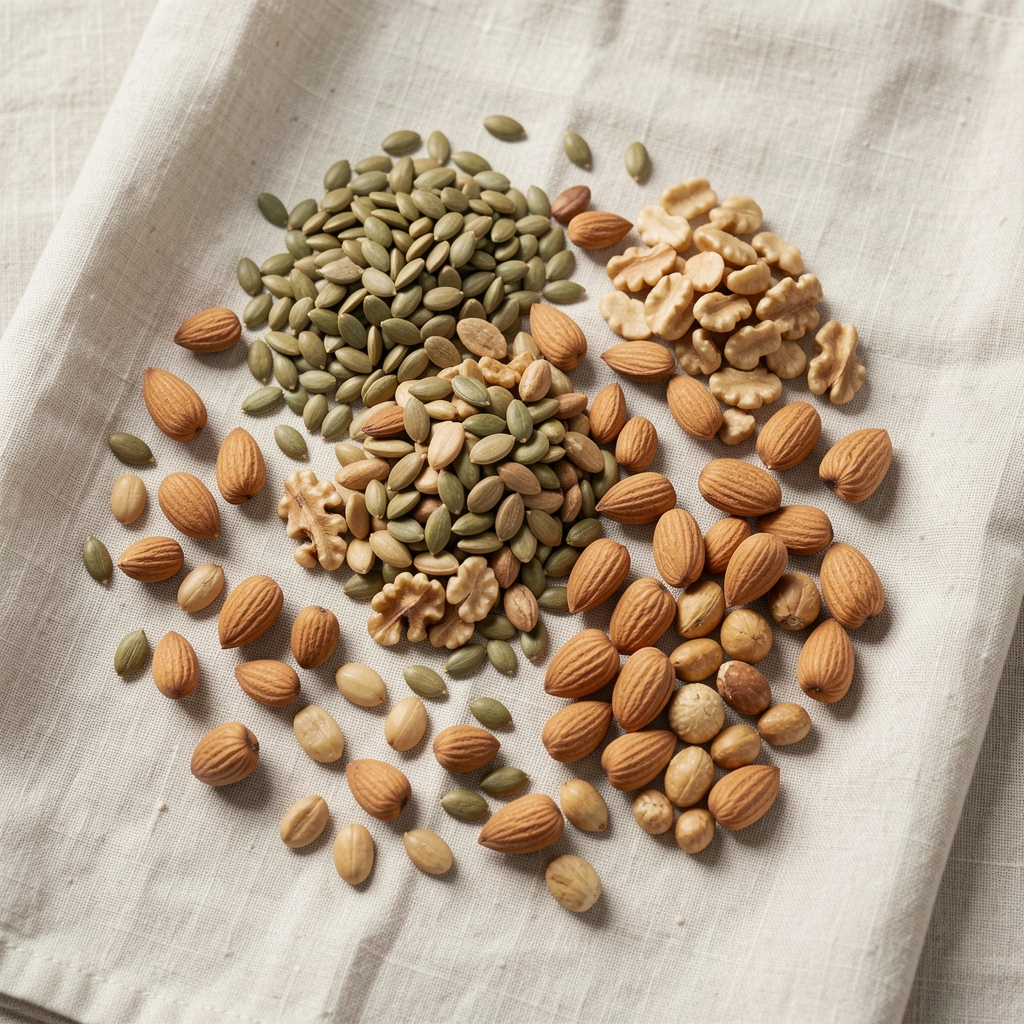
Jakarta, January 2026. In the dry-season heat of a South Jakarta morning, a certain pattern repeats across the kitchens and workspaces of active men. Beside the water glass, a zinc supplement capsule. On the counter, seeds and nuts pulled from a container. Magnesium, taken at night in some routines, placed near the evening meal. This field record follows four weeks of observation into how men navigating working and active lives in Indonesia structure their daily mineral intake — through both supplement habits and whole food sources.
The Mineral Landscape for Active Men
Among the nutritional considerations that appear consistently in published research on men's daily nutrition, zinc and magnesium occupy a particular position. Zinc contributes to daily nutritional balance and is found in meat, seeds, and legumes — food sources that appear regularly in Indonesian diets. Magnesium is associated with muscle function awareness and features in nuts, greens, and grains. The editorial team observed that knowledge of both minerals varied widely among the men who participated in conversations for this record.
What emerged from field notes was not a picture of men following rigid supplementation protocols, but something more characteristically Indonesian in its informality: a zinc supplement picked up at the neighbourhood health shop, taken alongside a breakfast of rice and egg. A magnesium capsule placed near the evening meal by a man who had read about it in an online editorial and wanted to try incorporating it into his evening routine. The supplement habit, in these cases, ran parallel to — rather than replacing — the whole food sources already present in daily eating.
Published nutritional research notes that dietary zinc intake can vary significantly based on the protein-richness of a person's regular eating pattern. For men with high activity levels, the body's demand for certain minerals may shift, though the precise degree of this shift is a subject that nutritional researchers continue to examine. What the editorial record captures is not a claim about outcomes but an observation about practice: men in Jakarta are thinking about minerals with greater regularity than they did five years ago, and the supplement aisle in their local stores reflects this.
Whole Foods as the Foundation
A recurring theme in conversations with participants was the relationship between supplementation and food. Several men described their supplement routine as a kind of backup to a diet they already considered reasonably balanced. "I eat tempeh most days," one participant noted. "The zinc is there in the food. The capsule is extra." Another described magnesium differently: "The nuts and greens are not always consistent in my week. When I know I have missed them, I take the supplement."
This pattern — supplement as supplement to diet rather than replacement of it — aligns with how independent nutritional sources tend to frame the role of mineral supplements. A daily zinc supplement supports nutritional variety alongside a diet that already contains zinc-rich foods; it is not positioned as a correction for a deficient diet but as an addition to an already considered one.
- Zinc-containing whole food sources — tempeh, seeds, lean meat — featured consistently in participants' regular diets
- Magnesium supplement habits often arose from reading rather than from professional guidance
- Most participants treated their mineral supplement as an addition to whole foods, not a replacement
- Evening magnesium routines were more common than morning, typically following physical activity
- Awareness of mineral complex products was rising, though single-mineral supplements remained more commonly purchased
The Supplement Aisle in Jakarta, 2026
The health product sections of Jakarta's larger pharmacies and modern minimarkets have changed noticeably over recent years. Where zinc was once a product found only in specialist wellness shops or sold primarily to people with a specific reason for seeking it, it now occupies a general supplement shelf alongside the multivitamins, vitamin C, and omega-3 products that have long been standard. Magnesium appears in several formulations: standard mineral, chelated versions, and magnesium-containing mineral complexes that combine it with zinc, calcium, and other daily minerals.
Field observations recorded the purchasing patterns of men in three different Jakarta districts over four weeks. The most common zinc product purchased was a standalone supplement at a daily dose consistent with nutritional reference values. Magnesium was more often purchased as part of a mineral complex. A smaller number of participants purchased both individually, following a supplement stack approach drawn from content they had read in editorial wellness publications.
"The supplement habit, in these cases, ran parallel to — rather than replacing — the whole food sources already present in daily eating."
Davorel Letters, Field Notes — Jakarta, January 2026Mineral Awareness and the Active Lifestyle
Among men who described themselves as physically active — gym attendance, running, football, cycling — the conversation around minerals took on a slightly different character. Not a concern with performance as such, but a broader awareness of the body's daily requirements. "When I train regularly, I notice when my nutrition is off," one participant noted. "It is not dramatic. But the routine matters."
This observation carries a particular relevance in the context of mineral intake. Both zinc and magnesium feature in the nutritional literature in relation to active men's dietary needs, not because activity makes supplementation essential, but because the dietary habits that support an active lifestyle tend to influence overall micronutrient intake. A man eating varied whole foods alongside a supplement habit is, in nutritional terms, approaching his daily mineral intake from two directions simultaneously.
Notes on Reading the Evidence
Nutritional research on minerals is extensive, and the editorial team at Davorel Letters applies an evidence-informed approach to how claims are presented. Zinc and magnesium are among the better-studied minerals in relation to men's daily nutrition; the published literature is broad enough that editorial writers can cite specific studies in support of specific observations. However, the journal takes care to distinguish between what the evidence records and what it recommends.
A consistent observation across the nutritional literature is that supplementing with minerals already present in a varied diet at adequate levels offers no additional benefit over that diet alone. The value of supplementation is typically framed in relation to dietary gaps — not as an enhancement of an already well-supported nutritional pattern, but as a filling of a specific absence. This distinction is central to how Davorel Letters covers the supplement aisle: with interest in what men are doing and why, not with promotion of any particular product or outcome claim.
What this field record concludes is not a directive but an observation: active men in Jakarta are incorporating zinc and magnesium into their daily supplement routines with growing regularity, and they are doing so against a backdrop of whole food awareness that suggests a more considered nutritional culture than existed a decade ago. The record of this shift is itself the editorial value.
Articles published on Davorel Letters are editorial in nature and reflect the writers' observations on men's dietary supplement habits and active lifestyle routines. The content is not intended as professional health advice. Readers with specific health concerns are encouraged to speak with a qualified health professional.

Jakarta — Whole food sources observed in participant daily routines, January 2026